

Coaching software with recovery in the same system as the training.
Programming, nutrition, recovery, messaging, check-ins and photos — one product, one database, built in one piece for how coaching actually runs.
3 clients free with no time limit and no card. $39 a month to 50.
Sunday 23 August
Today
HRV above your 30-day average, sleep 7h 42m.
78
Sauna
Scheduled 18:00
50 min
640
kcal remaining
The client app's Today screen, running. Sample client.
Pricing
Pick the band your roster already needs.
Priced on roster size and nothing else. Nutrition, programs, recovery, messaging, check-ins, photos and your branding are in every paid band, and every paid band holds two trainer accounts — Studio holds five. Paying for the year takes 15% off.
Free — 3 clients, 1 trainer. No card. One trainer, no branding, nothing expires.
Start with 3 clientsCoach
or $398 a year — save 15%
1 to 50 clients. Two trainers.
- 1 to 50 clients
- 2 trainer accounts — no extra charge
- Nutrition, programs, recovery, messaging
- Your branding, set up by us
Coach Plus
or $704 a year — save 15%
51 to 100 clients. Two trainers.
- 51 to 100 clients
- 2 trainer accounts — no extra charge
- Your branding, set up by us
- Same product as Coach
Coach Unlimited
or $1,316 a year — save 15%
101 clients and up. Two trainers.
- Unlimited clients
- 2 trainer accounts — no extra charge
- Your branding, set up by us
- The price stops changing here
Studio
or $2,540 a year — save 15%
A team. 5 trainers, unlimited clients.
- 5 trainer seats, unlimited clients
- Multi-trainer admin and roles
- Business reporting
Two coaches on every account, from $39
A partner or an assistant gets their own login, their own clients and their own roster — not a shared password. Most tools charge per seat. Studio takes it to five.
Full pricing detail — what is included, branding, and how the client bands work.
What it looks like
Every number a client owns, drawn before it is read.
These are the product's own charts against one sample client — not pictures of them. Thin lines, one hue per subject, no fills and no gradients: weight as a trend rather than a morning, nutrition against the target you set, recovery by modality, training by the week.
Weight — trend, not today
193.7
7-day average lb
−4.7 lb over 21 days
Sample client. Raw daily entries behind the 7-day average.
Nutrition — against the target you set
Sample day. Targets are the coach's own rows, read live.
Logging consistency — the shape of a week
Sample week. Outlines are days that were never logged.
Recovery — by modality, in minutes
Sample week. 148 minutes across five modalities.
Training — sessions per week
Sample client, twelve weeks. Empty columns are weeks off.
The same components the app renders. Sample client throughout.
Programs
A library of built programs, and a builder for your own.
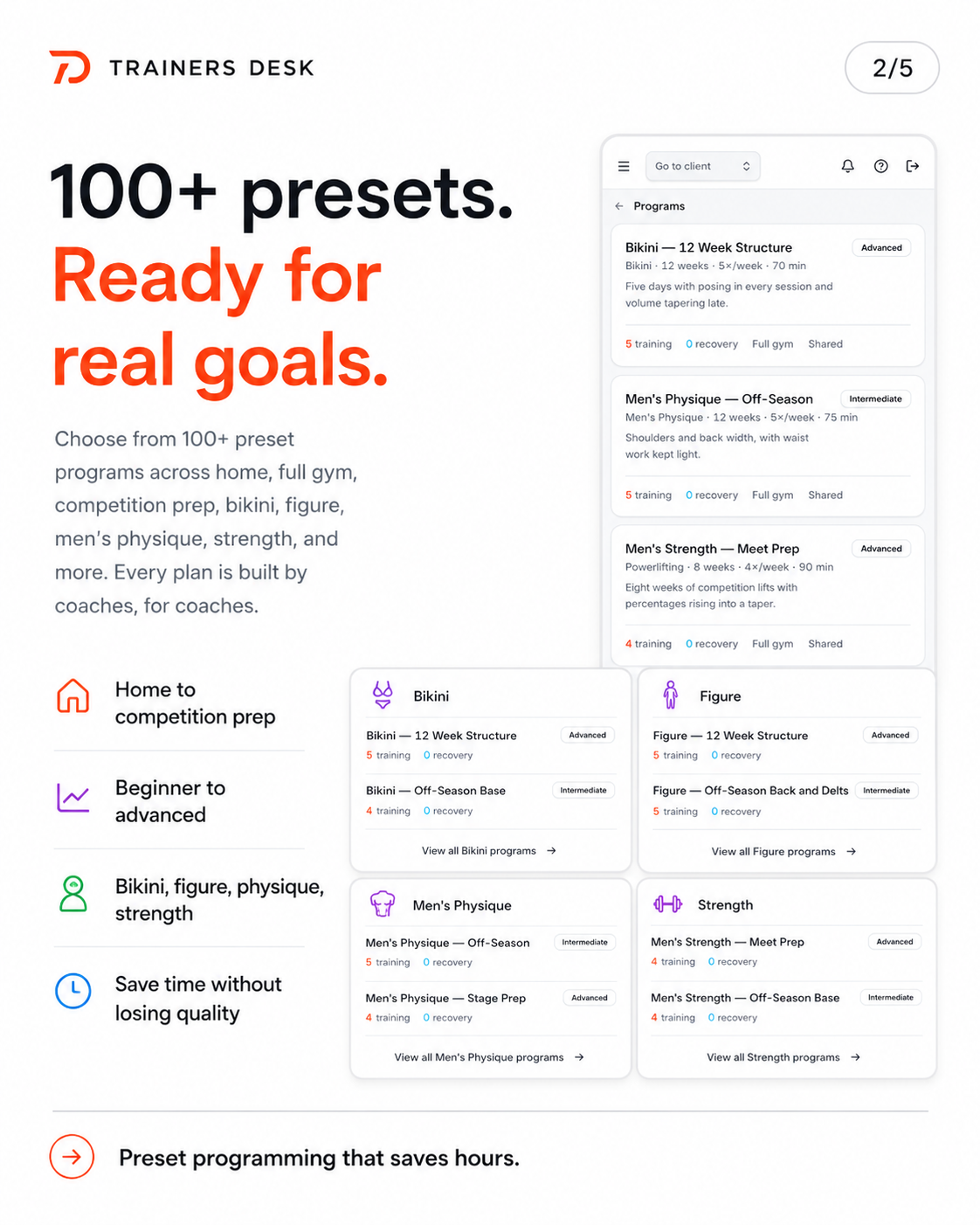
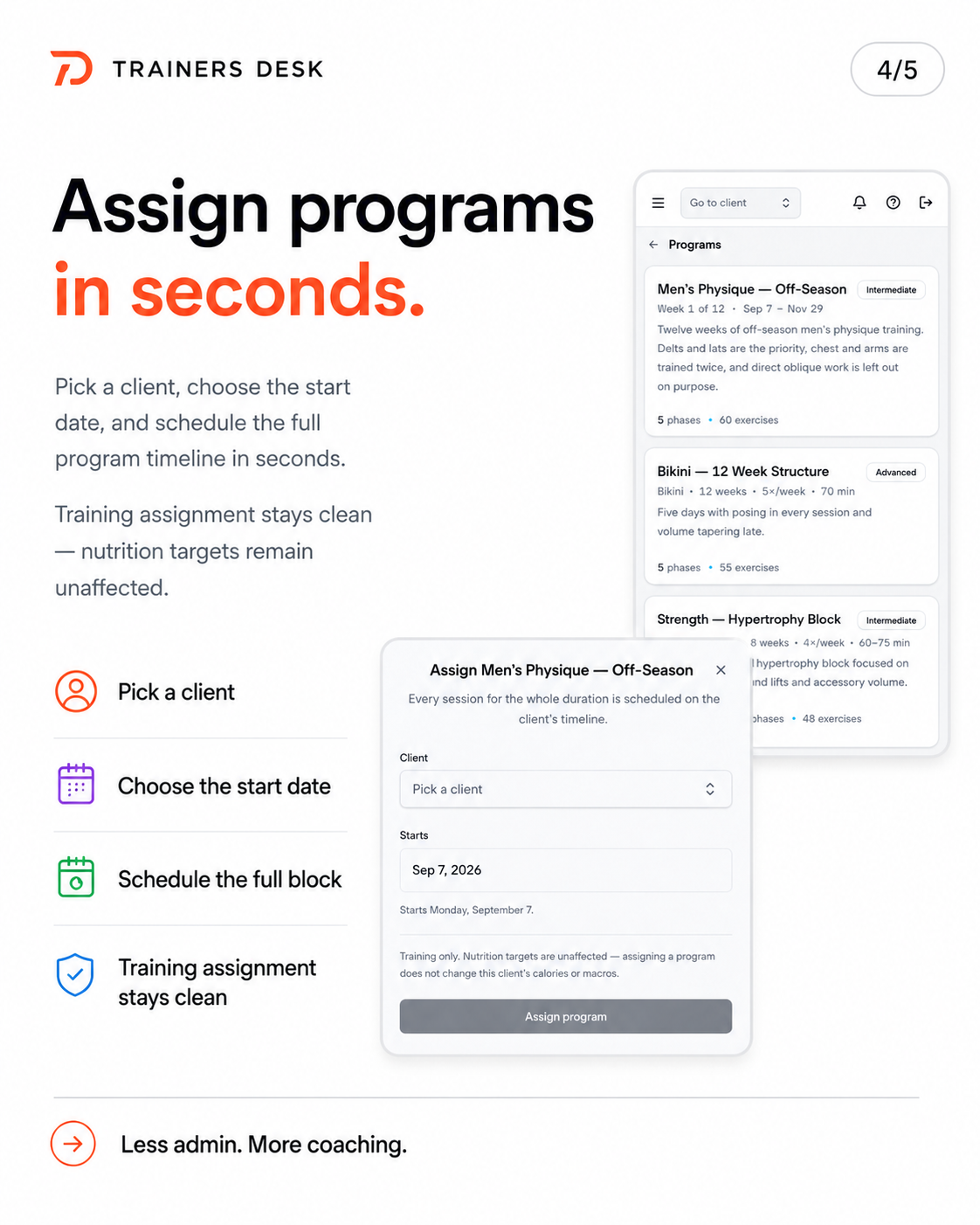
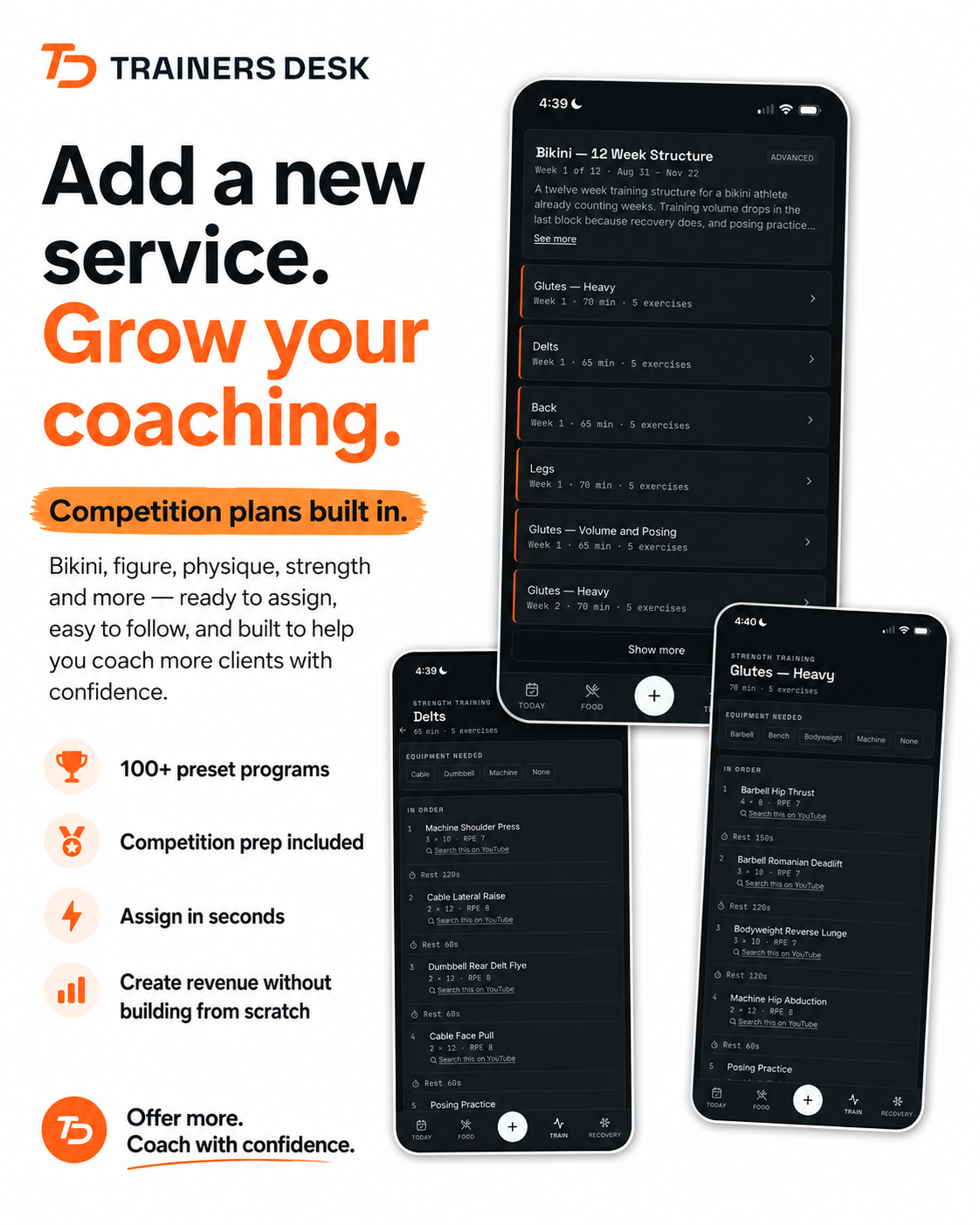
Over 100 programs are already in the workspace — home and full gym, beginner to advanced, strength blocks, off-season work and stage prep for bikini, figure and men's physique. Pick a client, pick a start date, and every session for the whole block lands on their timeline. Assigning training does not touch their calories or macros.
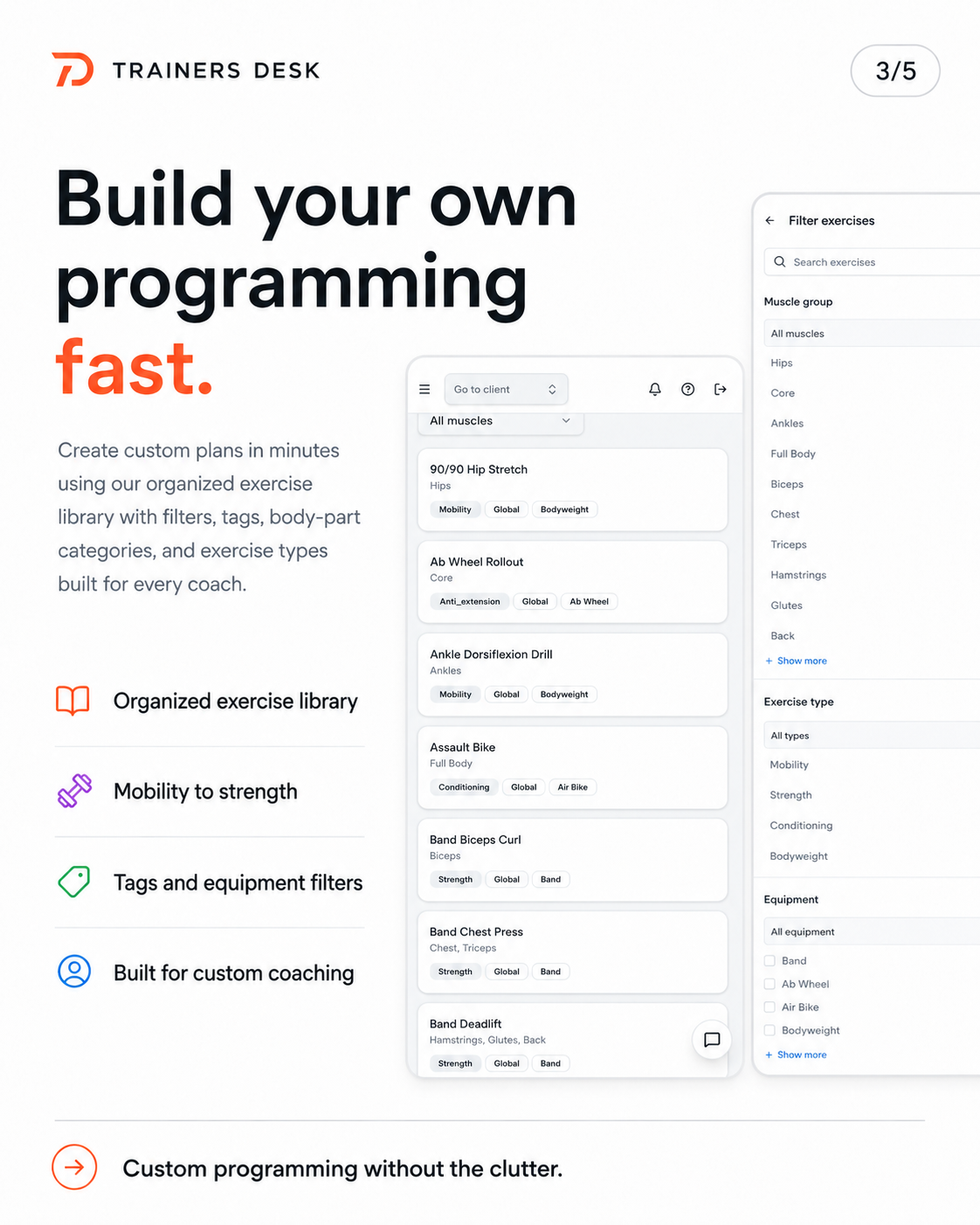
Building your own runs off the same exercise library the presets use, filtered by muscle group, exercise type and equipment, with sets, reps, RPE and rest on each line.
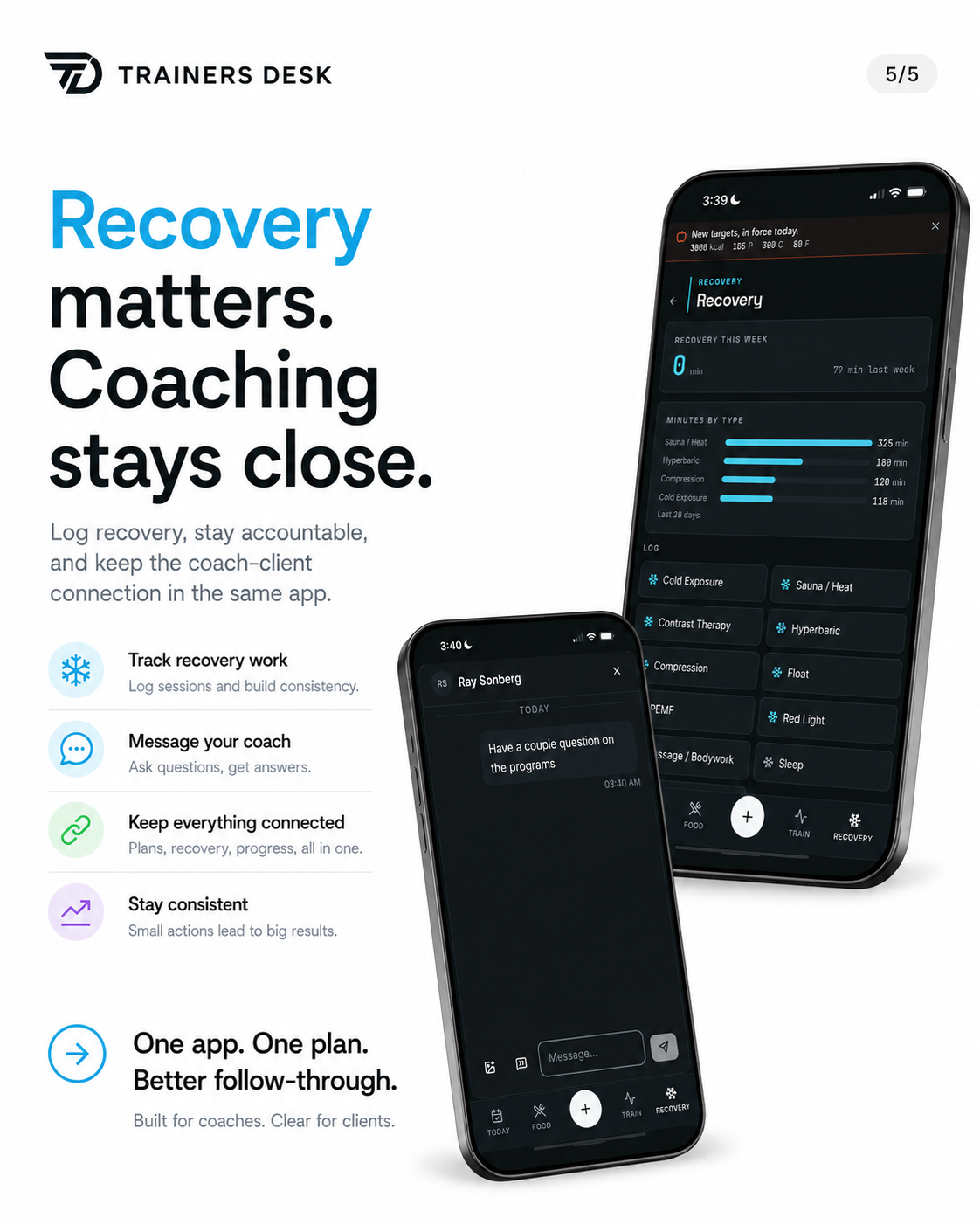
Recovery
Sauna, cold plunge and hyperbaric work are sessions, not notes.
Recovery is recorded in its own right, with duration and temperature, and drawn on the same seven-day scale as the lifting: training above the line, recovery below it. An hour of sauna draws the same length as an hour under the bar.
Above the line — training
4 sessions this week, the longest 90 minutes on Saturday.
Below the line — recovery
Sauna, plunge, hyperbaric, compression and mobility, plus sleep from the check-in.
The strip as it renders in both the client app and the console. Sample week.
One system, not four
A macro target is one row. Both of you are reading it.
Most coaches run a programming tool, a food app, a spreadsheet and a messaging thread, because the category was assembled over a decade of bolting one thing onto another. Every join between those parts is a copy of a number, and a copy has to be kept in agreement.
Here the target you set and the target your client logs against are the same record. There is no second copy to reconcile and nothing to sync, because there is only one number. A client's adherence is measured against the target that was in force that week, not against whatever was last typed in somewhere else.
Console — Jordan R., week of 24 August
- Calories
- 2,800 kcal
- Protein
- 180 g
- Carbs
- 300 g
- Fat
- 85 g
Set here. Written once.
Client app — Food, the same week
Read here. Not copied, not synced — the same row.
The same four figures in the console and in the client app. Sample client.
Nutrition data
Food data from USDA FoodData Central, marked in the app.
Search runs against USDA FoodData Central — the US Department of Agriculture's own database — with Open Food Facts behind it for packaged goods. Anything sourced from USDA carries a marker on the row, so a coach can tell at a glance which figures come from a government reference and which came from a label.
Crowd-sourced entries elsewhere are user-submitted and unverified. That matters when the adjustment is small: moving protein by 10 g against a number somebody typed in is not an adjustment, it is a guess. We would rather you know which kind of number you are looking at.
Restaurant and fast-food items are in there too — Big Mac, Whopper, a Wendy's Frosty, a Starbucks bottled Frappuccino — because USDA publishes its own survey data on chain menu items. We do not license a chain-menu database and never needed to. Coverage is the major national chains, updated on a multi-year cycle, so a regional chain or a menu item changed last month may be missing. A client builds that one from the chain's published numbers once and logs it in two taps for good.
The marker means the entry came from USDA FoodData Central.
Food search in the client app. Sample results.
The coach’s console
Four segments, computed before you sit down.
The console opens on who needs a program, who has gone quiet, who hit a personal best and who has not been messaged. No filter to build, no report to run — the lists are already there, computed from what your clients did and did not do.
Needs a new program
4
Program ended more than 7 days ago
Low activity
6
No session logged in 10 days
New personal bests
3
Heaviest set on a tracked lift
Not messaged lately
9
No message either way in 14 days
The overview segments as the console computes them. Sample roster of 62.
Branded for your business
Your name on their home screen, set up by us.
9:41
A home screen after a client saves the app. Sample brand.
On any paid plan you send us your business name, your logo, a square icon and the address you want. A person here configures it, checks the contrast on every screen and emails you when it is live — usually within two working days. It is not self-serve and there is no colour picker.
From then on a client opens your address, adds it to their home screen, and gets your icon, your name and your colour, with no browser bar. No app store, no developer account, no review queue, no extra charge. Emails to your clients show your business name as the sender; replies reach your own inbox.
On the free plan there is no branding — clients install on trainersdesk.com under the Trainers Desk name, and everything works the same. A listing in the stores under your own name is a separate service we quote per business.
Your clients' data
A billing problem never costs a client their history.
If a subscription lapses, or you leave, nothing is deleted. Your clients can still sign in and read everything they logged — weight, food, measurements, check-ins, photos and every past session. New logging stops while the account is inactive; the record stays.
Any client can ask for a copy of all of it from their own settings, at any time, whatever state the workspace is in. One file, emailed as a download link. We do not hold a person's health history hostage to a payment between us and their coach.
One successful payment brings the whole workspace back exactly as it was — no reactivation fee, nothing to set up again.
Built now, in one piece, by people who know what a coaching week looks like.
Take three clients on it for a week and see whether it holds up against what you use today. Nothing expires, and there is no card.